The weekly settlement cycle
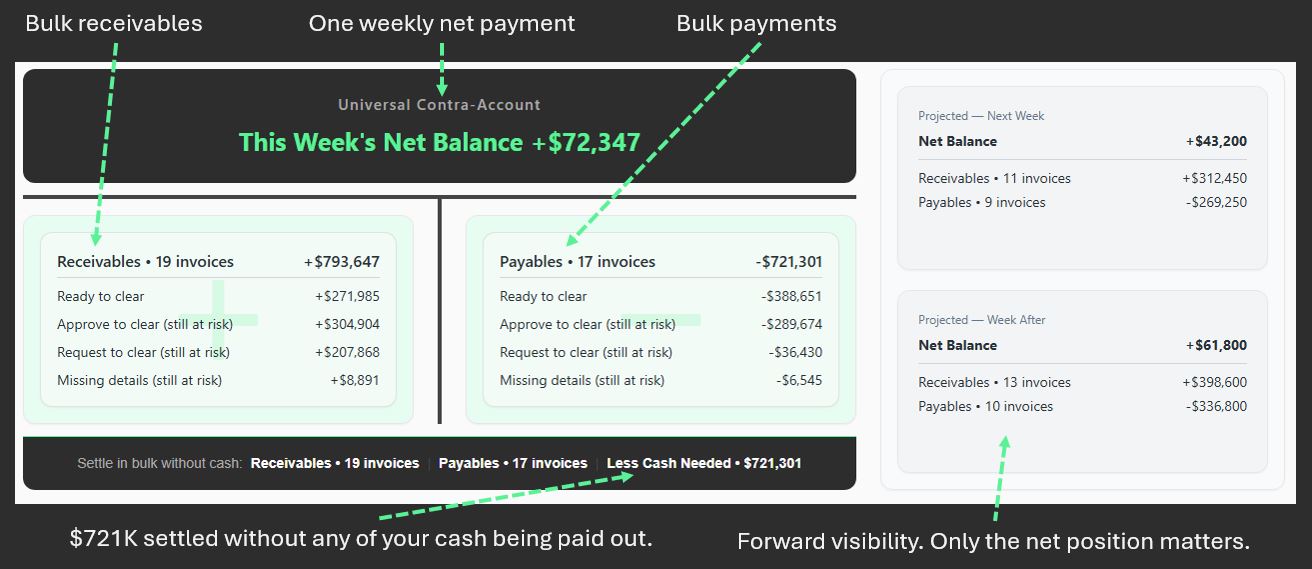
One weekly net payment. All cleared. Just like the banks have been doing for 200 years.

WHAT HAPPENS EACH WEEK
From invoice to settlement — here’s the full cycle.
Ongoing
Add invoices to your UCA. Your counterparty approves them for settlement.
Sunday Midnight
Cutoff. The upcoming week's approved invoices are locked in. The cycle begins.
Monday
Net negative balances are payable. One transfer out covers everything.
Mon — Fri
Any outstanding balances from prior cycles are settled during the week.
Friday
Net positive balances are disbursed. One transfer in. All cleared.
The principle is simple — everyone settles their own net balance.
One weekly cycle. All invoices cleared.
Q: What if I only have payables this week? Or only want to try the bulk payments?
A: You still benefit. Your payables are settled in bulk — one transfer out covers all your suppliers. Your suppliers benefit too, as they might use your invoice to net off against their payables.
Q: What if I only have receivables this week? Or only want to try the bulk receivables?
A: You still benefit. Your receivables are paid to you in bulk — one transfer for all your receivables. No chasing. Your customers benefit too — using the UCA, they can net your invoice against their own receivables, making it easier to settle your invoice.
See it in action
What your Universal Contra-Account looks like in practice
Questions We’re Often Asked
Q: What is a Universal Contra-Account? You know how a normal contra-account works — I owe you $10, you owe me $15, we settle the $5 difference. A Universal Contra-Account works the same way, but extended to all your trading partners at once. Banks use something similar to net off millions of payments between themselves every day. Now it’s available to any business.
Q: Do I need special software? No. Clearitt works alongside your existing systems. Nothing to install or change.
Q: What if my trading partners don’t join? We prepare the invitation emails for you — you just choose who to send them to. A UCA is mutually beneficial — invoices can be settled with less cash on both sides, so trading partners tend to say yes. The more that join, the more everyone can net off.
Q: When does the UCA start delivering? A bilateral contra-account only works when there’s a willing counterparty on the other side. Otherwise you can’t net off and have to pay gross.
A UCA works the same way. Your trading partners need to be willing and ready to net too. The more that join, the better it works for everyone.
Invite your trading partners — it’s free, and when invoices net off, all parties save cash. You’ll be notified when network density is high enough and your first netting cycle is ready to run.
Q: How often does netting off happen? Once a week. All invoices due that week are netted off in a single weekly cycle. You receive or pay the difference — one transfer, all settled. Invoices due in future weeks are netted off when they fall due.
Q: What happens if someone doesn’t pay their net balance? They are suspended from the next netting cycle. Their creditors receive a proportionately reduced disbursement, held until the outstanding amount is settled.
Q: Can fake invoices be cleared through the UCA? No. Both parties to an invoice must explicitly approve it for UCA settlement before it can be netted off. This means every invoice requires confirmation from both the buyer and the seller — adding an extra layer of protection that doesn’t exist in standard payment flows.
If an invoice is disputed or unrecognised, either party can decline to approve it. It then falls back to gross payment or dispute resolution as normal.
Q: Is my financial data safe? Yes. Data is held in Australia, encrypted, and covered by The Privacy Act 1988. We cannot access your accounting platform data without your explicit permission, which you can revoke at any time.
Q: Will Clearitt sell my data? No. Individual business data is encrypted so that even Clearitt cannot read it. What we work with is anonymised and aggregate. It’s not a policy. It’s architectural. Your data stays yours.
Q: Do I need to trade with everyone on the platform? No. You only ever deal with your own customers and suppliers. Clearitt coordinates the netting behind the scenes — just like banks don’t need direct relationships with every other bank to net off billions daily. You bring your trading relationships. The UCA does the rest.
Q: What if I have no receivables this week? You can still settle all your payables in bulk with one single payment. And you’re benefitting all your suppliers at the same time — your payment helps them net off at their end.
Q: What if I have no payables this week? You can still settle all your receivables in bulk with one single payment. No chasing. And you’re benefitting all your customers at the same time — it helps them net off at their end. On an average week your customer carries a positive net balance, so settling your invoice costs them no cash at all.
Q: What’s the difference between UCA Member, Connector and Partner? All three are free. The difference is how much you put in — and how much you can net off. UCA Member gets you listed and your UCA set up. UCA Connector means you’ve uploaded your trading partners so they can find you. UCA Partner means you’ve invited them directly — the most effective way to build your netting pool.
Q: Can I change my public profile URL? Yes, but any existing links will break if you do — including links in email signatures, invoice footers, or anywhere else you’ve shared it. Update those links after changing your URL.
Q: Can I get more details around the accounting aspects of a UCA? Yes, here is a link to our accounting guide → UCA-—-Accounting-Guide
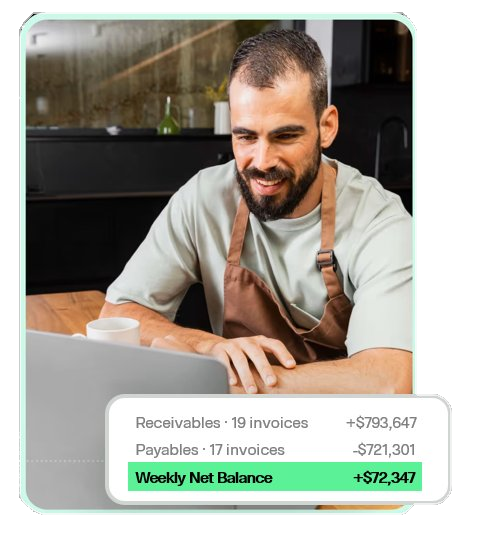
Enter your ABN to check if any of your trading partners already have a UCA.

We work with your existing tools
Clearitt connects directly with Xero, MYOB, and Reckon. Can’t see yours? Every business can import and export invoices via spreadsheet — so if your platform can export a CSV, Clearitt can work with it using our AI reader. More integrations added based on demand — let us know what you use.